
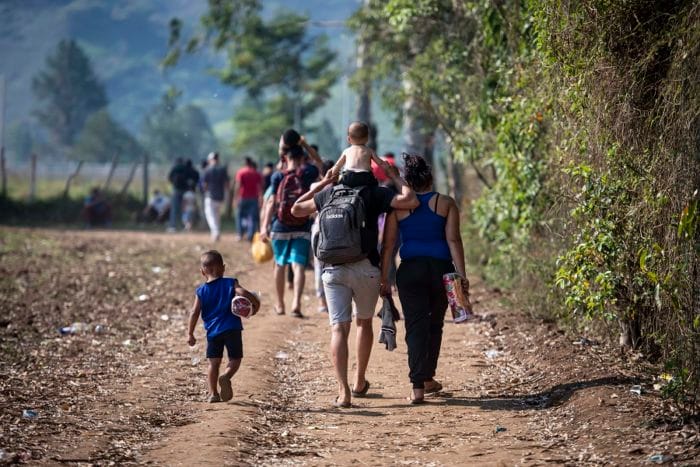
During 2022, 2023, and part of 2024, Ortega Murillo, with the support of Venezuela, Cuba, Russia, and other countries with totalitarian regimes, organized the most significant and complex operation for trafficking migrants to the United States. To facilitate transit through Nicaragua, the dictatorship eliminated the visa requirement for Cubans and then for citizens of Asian and African countries. This practice strengthened the traditional land route through the Darien Gap and the maritime route through San Andrés Island in Colombia.
It thus established a policy of universal visa-free travel, through the payment of a tourist card obtained upon entering the country by air, sea, or land, and the option of obtaining a temporary transit permit or safe-conduct, which allows travel to the northern border after paying a fee of between $150 and $300.
Air routes were subsequently added, and the operation required meticulous preparation with contacts in different countries, travel agencies, airlines, and groups specializing in human trafficking to turn Managua’s Augusto C. Sandino International Airport into a hub for the illegal trafficking of migrants.
This mechanism operated with the support of its allies, involving around 1,500 charter flights from destinations as diverse as Haiti, India, and Libya.
They continue to exploit migration
In addition, airlines with established routes, especially Venezuela’s Conviasa, facilitated the trafficking of migrants from Cuba and Venezuela. It is estimated that between 2022 and 2023, some 628,700 migrants used the facilities of the Managua International Airport, which was used mainly by Cubans and Venezuelans. But also by citizens of Afghanistan, Uzbekistan, Tajikistan, Georgia, Vietnam, China, Kyrgyzstan, Angola, Burkina Faso, Mauritania, and Senegal, among others.
In June 2024, the United States used its diplomatic measures to suspend visas for owners and operators of charter flights to stop these flights. However, they couldn’t limit Conviasa’s operations or regular flights, which are mainly operated by Latin American airlines that transport passengers of different nationalities, who arrive in Nicaragua after making several stops.
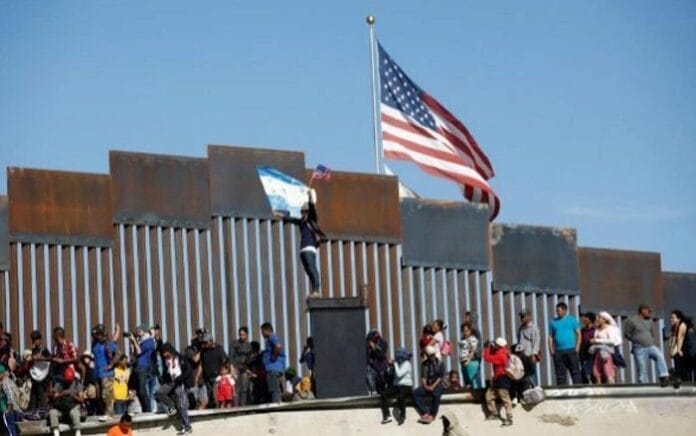
Although there has been a notable reduction in the number of illegal migrants due to the impact of the measures promoted by the Trump administration, the institutional facilities provided by the Ortega Murillo dictatorship and its hybrid warfare policy of attacking the United States by exploiting migration remain intact.
The universal free visa facilities continue to be attractive to migrants who decide to take the risk, despite the increasing difficulties in entering the United States, as well as for the selective transit of agents from countries that oppose that nation, or worse still, members of terrorist groups, which is why the Managua hub continues to be seriously affected, but fully operational.
Migration as part of hybrid warfare
According to information from the National Institute of Migration (INM) of Honduras, between January and October 2025, an average of 3,000 irregular migrants per month entered the country from Nicaragua. Among them were nationals from Cuba, Haiti, Venezuela, Iran, China, Cameroon, Uzbekistan, Bangladesh, Afghanistan, Pakistan, Ethiopia, and Syria, among others.
These data are consistent with those provided by the U.S. Customs and Border Protection (CBP), which reports monthly averages of about 30,000 migrants detained, but this figure includes Mexicans, Guatemalans, Hondurans, and Salvadorans.
On November 17, the U.S. Department of State reacted to the sustained flow facilitated by Nicaragua. It suspended visas for owners, executives, and senior officials of transportation companies, travel agencies, and tour operators who, thanks to the permissive immigration policy of the Ortega Murillo dictatorship, facilitate the transfer of migrants through Nicaragua.
For the Nicaraguan Democratic Concertation (CDN), the measures promoted by the State Department against individuals ignore the levels of centralization of power by the Ortega Murillo regime, therefore, the criminal structure and its international coordination for migrant trafficking will continue to be active.
As long as the Ortega Murillo regime observes that the irregular migration they promote continues to cause a strong division in US society, and they are not directly affected by the State Department’s measures, or feel at risk of losing power, in coordination with their allies in the totalitarian regimes of Russia, China, Iran, North Korea, Venezuela, and Cuba, they will continue to exploit irregular migration as an exercise in hybrid warfare to destabilize their adversary.
Ortega’s religious persecution
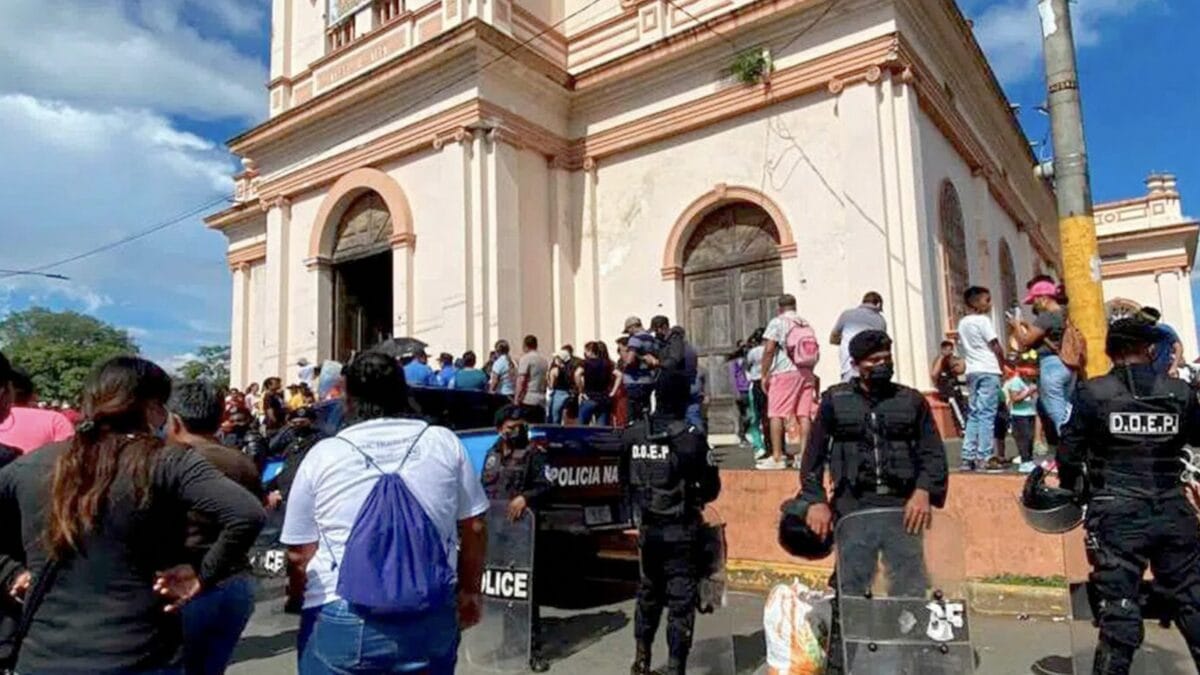
In its report this year, the United States Commission on International Religious Freedom (USCIRF) maintained Nicaragua’s status as a country of “Particular Concern.” This category, the most severe, implies that persecution is systematic, ongoing, egregious, and flagrant, and is reserved for the most violent countries.
The USCIRF is an independent, bipartisan federal agency that monitors religious freedom, considered a universal human right, around the world. It also makes recommendations to the US president and Congress on foreign policy regarding freedom of worship. Its reports have led to diplomatic pressure and even the imposition of sanctions on countries that violate religious freedom.
The most recent report singles out the Ortega Murillo regime as one of the world’s worst violators of religious rights and recommends, among other measures, financial sanctions and the reinstatement of the RENACER law.
Daniel Ortega’s abuses against the Catholic Church are well documented and have received much attention in the Nicaraguan and international media.
The Sandinista regime has a long history of abuses against religion and the Catholic Church in general. The humiliation of Father Bismark Carballo and the disrespect shown to the Holy Father Saint John Paul II during a solemn Mass he celebrated in Managua in 1983 are just two of the best-known examples, but there are many more.
Religious solidarity
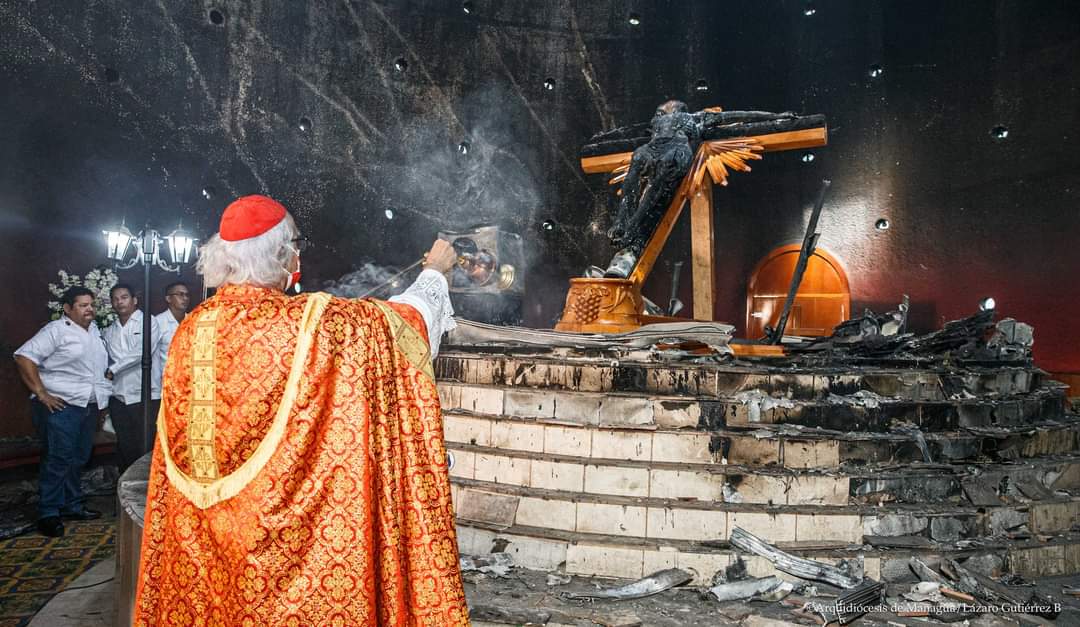
In 2018, when protests broke out and the police began killing dozens of students and young demonstrators, the auxiliary archbishop of the Archdiocese of Managua, Monsignor Silvio Báez, told the hundreds of demonstrators who had taken refuge in the Cathedral of Managua: “Do not give in to intimidation, do not be carried away by violence, your struggle is just and the Church supports you. Not only does it support you, but we urge you to continue… Your cause is for social justice, continue to believe in the power of peace and nonviolence.”
But Ortega resumed the repression of yesteryear, albeit with much greater force from 2018 onwards. Almost three hundred priests and religious figures are in exile, some were expelled and others have not been allowed to return to the country. The bank accounts of Catholic parishes were frozen, their social works were closed, and they were prohibited from holding processions.
Higher education institutions belonging to religious organizations, including the Central American University (UCA), were arbitrarily confiscated, the apostolic nuncio Waldemar Stanislaw Sommertag was expelled from the country and the series of abuses committed against bishops and the Church have been extensively documented, prompting the USCIRF to maintain Nicaragua in the worst category of its report.
Nicaragua’s designation as one of the countries with the highest levels of religious persecution in the world comes at a time when Pope Leo XIV, despite having been on the throne of St. Peter for only a short time, has already met with three exiled bishops: Báez, Rolando Álvarez, and Carlos Herrera.
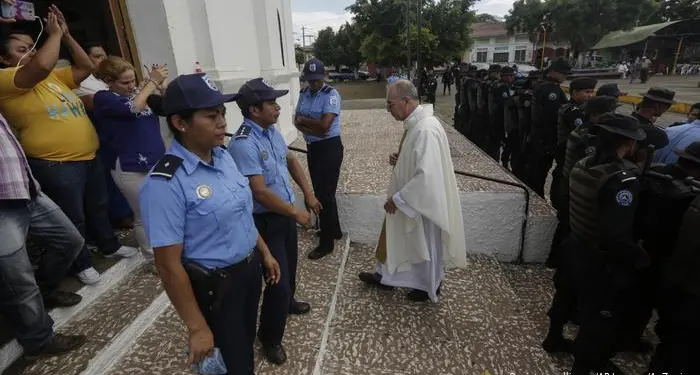
Consequences of religious persecution
According to a publication by El Pilar, a media outlet specializing in religious issues, the Vatican’s interest in these meetings is to send a clear message to Ortega: only the Holy See will determine who is appointed bishop. And by meeting with the aforementioned bishops, it confirms that, although exiled, they remain in their ecclesiastical positions and, as such, continue to be important leaders of the Church in Nicaragua.
According to the publication, Pope Leo XIV then tells the Ortega Murillo regime that he will not play along with their game of appointing bishops who are sympathetic to them, such as René Sándigo.
For this reason, the Nicaraguan Democratic Coalition (CDN) believes that religious persecution will generate more than just political expressions of international condemnation for Nicaragua. On the recommendation of the USCIRF, the United States government could apply sanctions. These would be considered under the parallel process carried out by the Office of the United States Trade Representative (USTR) Section 301 investigation.
In addition, Vatican policy toward Nicaragua is shifting. It is moving from a certain prudence to a more active policy and closer ties with the Nicaraguan Catholic hierarchy in exile.
Meanwhile, in Nicaragua, the persecuted Catholic Church continues to evangelize and support a people who, although subjugated, will always be Marian, Catholic, and Christian, despite the attempts of the Ortega Murillo dictatorship to impose its authoritarian will and silence the prophetic voice of the bishops and other religious leaders.